
20 May 2026
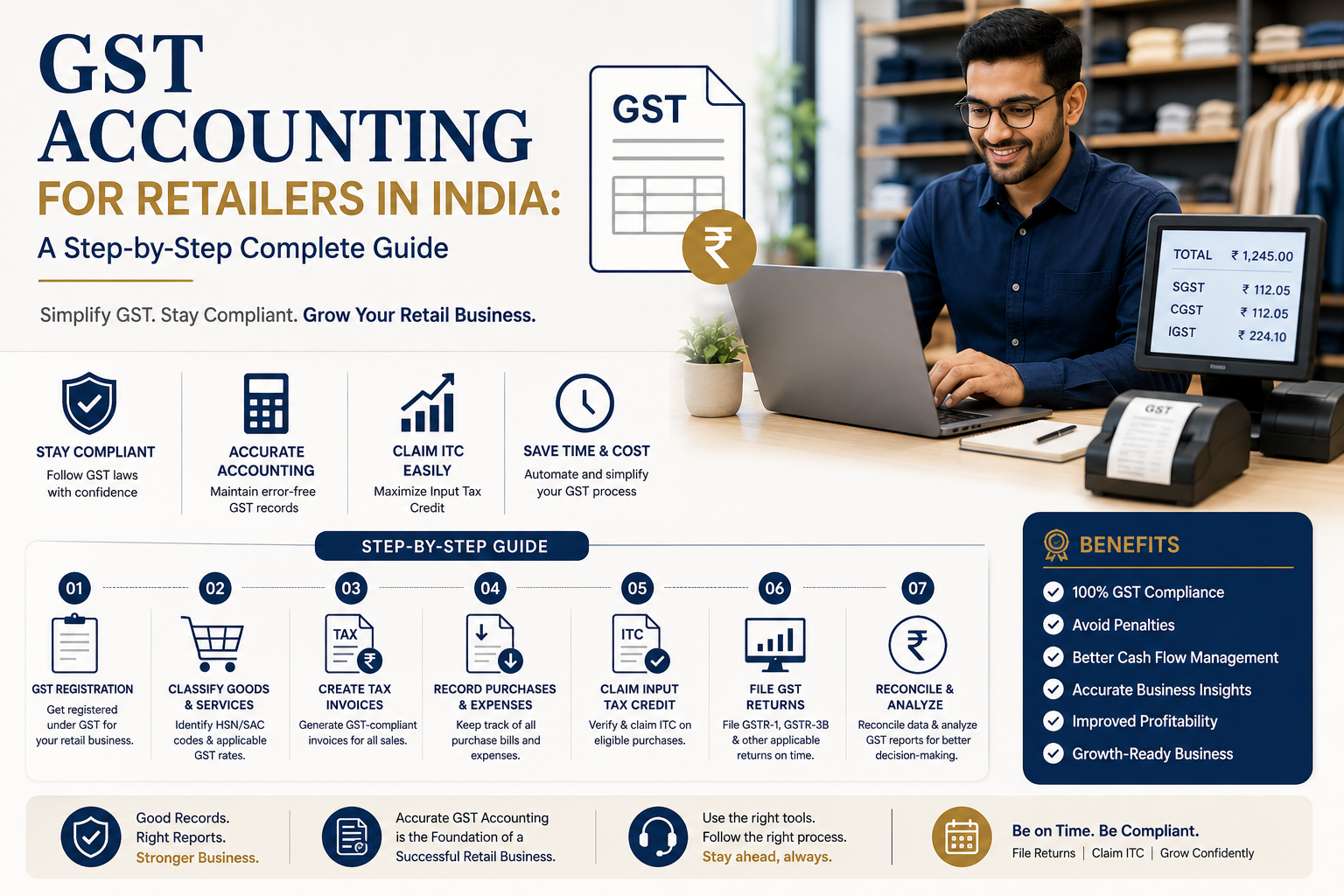
Running a retail shop in India is hard work — juggling inventory, staff, supplier payments, and ever-changing customer demands. The last thing you want is a GST notice landing because of a filing error or a missed reconciliation. Yet, GST accounting for retailers in India trips up thousands of shop owners every single month, not out of carelessness, but because the rules are genuinely layered.
You might be selling sarees in Surat, electronics in Bengaluru, or groceries in a Pune suburb. Different product categories, different tax slabs, different ITC rules. Most accountants give you the broad strokes—but the practical, day-to-day stuff? That’s where things get murky.
This guide cuts through the confusion. Whether you’re running a standalone kirana or a mid-size retail chain, here’s what smart GST accounting for retailers in India actually looks like — not in theory, but on the ground.
GST replaced a tangle of older taxes—VAT, central sales tax, octroi, and service tax—when it was introduced in July 2017. For retailers, this theoretically simplified the tax environment. One country, one tax. In practice, you’re still navigating four main slabs (0%, 5%, 12%, 18%, and 28%) along with HSN codes for every product category.
Here’s how the retail flow works: you buy stock from a supplier and pay GST on your purchase. You sell to customers and collect GST at the point of sale. The difference between what you collected and what you paid is your net GST liability—and understanding this gap is the heart of GST accounting for retailers India.
Essentials like fresh produce and most grains sit at 0%. Packaged staples, footwear under ₹1,000, and basic FMCG often attract 5% or 12%. Garments above ₹1,000, electronics, and discretionary goods typically fall in the 18% slab. A few items—pan masala, tobacco, and high-end cars—attract a 28% plus cess. Know where your products land before you set prices.
If your annual aggregate turnover is below ₹1.5 crore (₹75 lakh for certain service categories in special category states), the Composition Scheme is worth a serious look. Under it, you pay a flat 1% GST on turnover instead of managing the full return cycle. No monthly GSTR-1, no ITC reconciliation headaches — just a quarterly statement (CMP-08) and an annual return (GSTR-4).
The trade-off is real, though. You cannot issue a regular GST tax invoice, which means your business buyers can’t claim ITC from purchases made at your store. If a significant portion of your customers are other businesses or traders who need input credit, composition will cost you their business. For a neighborhood grocery, hardware shop, or apparel store catering to walk-in consumers, it’s often the smarter move.
Also note: once your turnover crosses ₹1.5 crore, even mid-year, you must migrate to regular GST registration. Keep an eye on monthly sales figures — missing this threshold can attract penalties.
Good GST accounting for retailers in India starts with clean, consistent recordkeeping. There’s no shortcut here. The records you maintain today are the same ones that will protect you during a scrutiny or audit tomorrow.
You need to track:
You don’t need enterprise software to manage this for a small store. A billing tool with GST compliance built in — generating GSTIN-compliant invoices automatically and syncing purchase data — handles most of it. The key is consistency: update records daily, not at quarter-end.
ITC is one of the most valuable parts of GST for retailers — and also one of the most misunderstood. When you buy goods from a GST-registered supplier, you pay GST. That paid amount becomes a credit you can use to offset your GST liability when you sell.
Here’s a quick example. You buy apparel worth ₹2,00,000 from a Tirupur wholesaler at 12% GST (₹24,000 paid). You sell it for ₹3,00,000, collecting 12% GST (₹36,000). Your net GST payable is ₹36,000 – ₹24,000 = ₹12,000. The ₹24,000 ITC effectively reduces your outflow.
But ITC doesn’t come automatically. Your supplier must file their GSTR-1, and the invoice must show up in your GSTR-2B. If they don’t file — even if you paid them — you lose that ITC. Working with GST-compliant suppliers isn’t just good practice; it’s financially critical.
ITC is NOT available on: goods bought for personal use, stock lost or destroyed, motor vehicles (for most retailers), and specific blocked categories listed under Section 17(5) of the CGST Act. Always verify eligibility with your accountant before claiming.
For regular registered retailers, the return cycle looks like this:
Under the QRMP scheme, small retailers file GSTR-1 quarterly but still pay tax monthly through a fixed-sum challan. This significantly reduces paperwork without altering your payment obligations.
Late filing attracts a fee of ₹50 per day (split between CGST and SGST) for returns with tax liability, or ₹20 per day for nil returns. These look small in isolation but stack up quickly—a two-month delay on a taxable return costs ₹3,000 in late fees alone, before any interest.
Most GST problems in retail don’t come from deliberate evasion. They come from overlooked details that compound over time. Here are the ones that show up most often:
Every product has an HSN (Harmonized System of Nomenclature) code that determines its GST rate. Using the wrong code — even accidentally — means the wrong tax is charged and collected. During a GST audit, mismatched HSN codes raise red flags. Verify codes for your top 20 products and lock them into your billing software.
If a supplier doesn’t file their return, their invoice won’t appear in your GSTR-2B. The ITC you claimed in GSTR-3B for that invoice will be disallowed — often discovered months later during annual reconciliation. Monthly 2B matching, not year-end matching, catches this early and gives you time to chase the supplier.
When you buy from an unregistered supplier and the transaction falls under RCM, you’re required to pay GST yourself — even though the supplier didn’t charge any. Many retailers are unaware of this obligation, especially for services like freight, legal fees, or security services. Unaddressed RCM can accumulate into a significant underpaid liability.
Under GST, every supply of goods to a consumer above ₹200 must be accompanied by a bill of supply or a simplified tax invoice. Many small retailers skip this for cash transactions — it’s risky legally and creates stock reconciliation gaps that are hard to explain during an audit. Get your billing software to auto-issue bills regardless of payment mode.
Manual ledger-based GST accounting works for a shop with ten transactions a day. For anything more, it’s a liability. A billing and accounting tool built for Indian GST compliance should:
Platforms like Taxxa.in are built specifically for Indian GST compliance needs. The software handles the filing logic behind the scenes — so you can stay focused on your store and customers instead of portal logins and return deadlines.
Q1. What is the GST registration threshold for retailers?
Retailers with annual aggregate turnover above ₹40 lakh (₹20 lakh in special category states) must register for GST. If you cross this limit at any point during the financial year, you must register within 30 days. Crossing the limit even by ₹1 triggers mandatory registration — there’s no grace period. Some states have notified different thresholds, so confirm with a CA or the GST portal.
Q2. Can retailers claim ITC on goods purchased for resale?
Yes, ITC is fully available on goods bought for resale, subject to conditions. Your supplier must be GST-registered, their GSTR-1 must be filed, and the invoice must appear in your GSTR-2B. You must also have actually received the goods and paid for them. ITC that doesn’t reconcile with GSTR-2B is subject to reversal, so monthly reconciliation is essential.
Q3. What is the Composition Scheme for retailers and who should use it?
The Composition Scheme allows retailers with annual turnover below ₹1.5 crore to pay a flat 1% GST on turnover instead of filing complex monthly returns. It dramatically reduces compliance burden. The downside: you cannot issue regular tax invoices, so your business buyers can’t claim ITC. It’s ideal for small retailers selling primarily to end consumers — grocery stores, local apparel shops, hardware stores.
Q4. How often must a retailer file GST returns?
Regular registered retailers file GSTR-1 and GSTR-3B monthly. Those with turnover under ₹5 crore can opt for the QRMP scheme and file GSTR-1 quarterly while making monthly tax payments. The annual return GSTR-9 is due once a year. Composition dealers file CMP-08 quarterly and GSTR-4 annually. Missing any deadline attracts late fees and interest on outstanding tax.
Most retailers who get into GST trouble didn’t miss a filing intentionally. They missed it because no one built a system — a process for monthly reconciliation, a filing calendar, a clear division between what the accountant does and what the shop owner checks. GST compliance isn’t a one-time setup job. It’s an ongoing habit, and the earlier you build it, the cheaper it stays.
Start with the fundamentals: maintain clean purchase and sales records, reconcile your GSTR-2B every single month, and file on time even when there’s nothing to pay. If your turnover is under ₹1.5 crore, evaluate the Composition Scheme honestly — the paperwork reduction can be significant for a store with mostly retail customers. If you’re a larger retailer with varied inventory across categories and both B2B and B2C customers, proper software and a dedicated GST-literate accountant aren’t expenses; they’re insurance.
GST accounting for retailers in India has improved considerably since 2017 — the portal is more stable, GSTR-2B has made ITC reconciliation more systematic, and the QRMP scheme has reduced the compliance burden for small retailers. The tools available today make staying compliant far more manageable than it was in the early years. But no software or policy update removes the need for attention and discipline on the shop owner’s end.
Don’t wait for a notice. A demand notice with penalty and interest costs far more than a few hours spent getting your GST records in order right now. Taxxa.in is built for Indian retailers who want accurate, compliant GST accounting without drowning in complexity. Visit taxxa.in and see how it can take the stress out of GST for your store.
No comments yet. Be the first to comment!